

My dream job after secondary school was to become a Nuclear Engineer. I was inspired after my Physics class introduced nuclear energy in the last section. “Nuclear energy explains the energy generated through reactions between subatomic particles,” said Rev.Sr. Jancita (yeah, I attended a catholic school). “We’ve not been able to harness nuclear fusion1 as a source of energy even though it is abundant”. Right there, I decided to become a nuclear engineer. In fact, I wrote my career ambition in our bootleg yearbook: to be the guy who makes nuclear fusion a reality. 13 years later, it is safe to say the dream is dead, and I haven't been able to resurrect it.
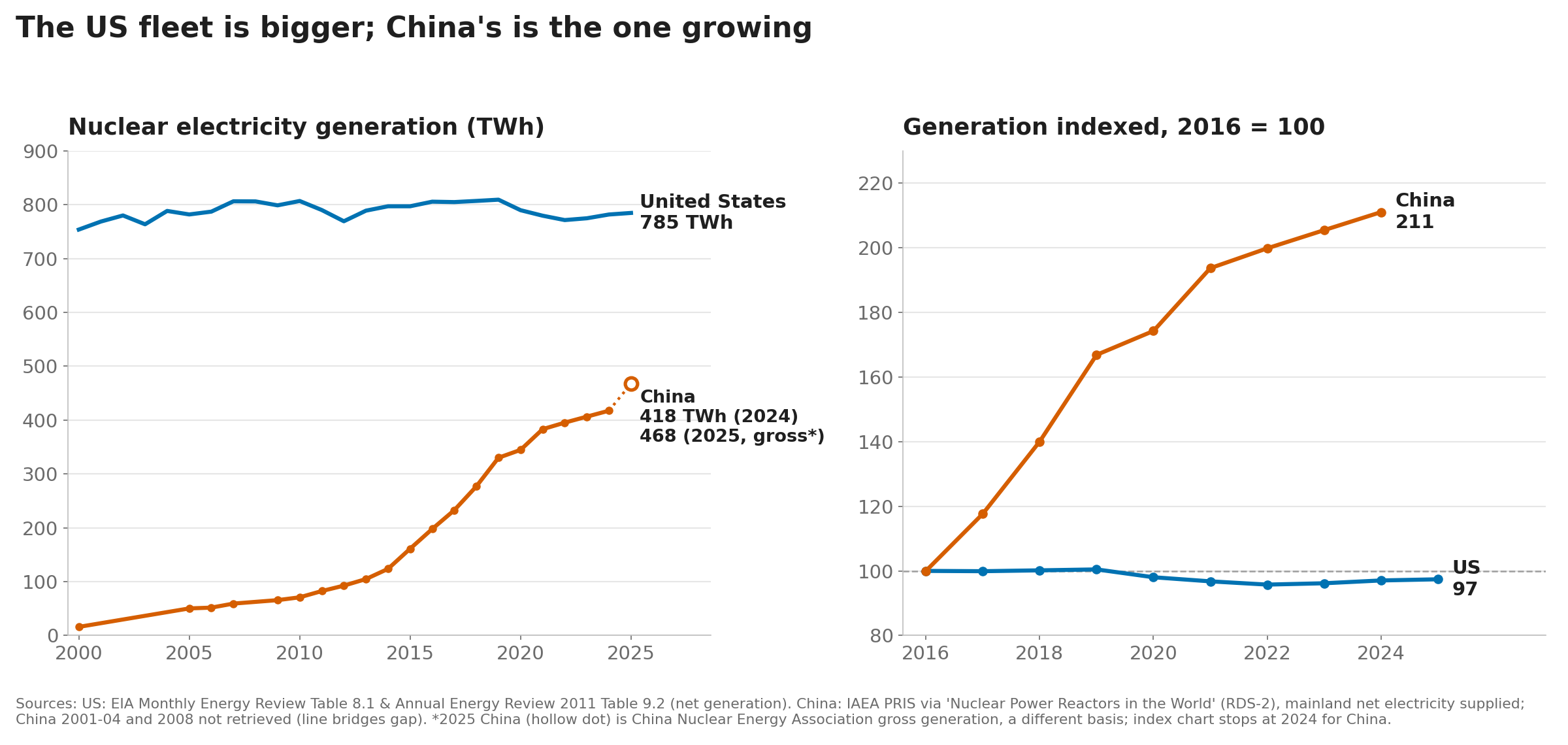
Like me, the Nuclear Energy industry in the United States has also underperformed on its ambitions. In 1990, the US had 112 operating nuclear fission2 reactors, generating about 576.9 TWh,3 19% of total electricity generated that year, at 66% capacity4. Fast forward to 2025, the US has 94 reactors operating, generating ~785 TWh (17.4% of total electricity generated) at 91% capacity. While the net loss of 18 reactors didn’t change output much, because keeping them online would have raised output by only 1 to 3%, the real decline is that nuclear energy generation has not kept pace with growth in electricity demand. To maintain the 19% share it contributed in 1990, it would need to produce 58TWh more than it does today.
Several factors contribute to this shortage. One is that building nuclear power plants has become far more expensive and slower. According to the Institute for Progress, the overnight cost of building a US reactor has increased roughly 6 to 7 fold since the late 1960s. Because of this cost/uncertainty, natural gas became the safer bet. The country built about 270,000MW of gas plants between 1992 and 2005; however, in that same period, nuclear plant construction was essentially flat. In 2011, economist Lucas Davis concluded that if the economics didn’t change, a nuclear power renaissance seemed unlikely, and he was right; recent attempts failed. V.C. Summer, initiated in 2008, was abandoned 9 years later because of ballooning costs, delays and the contractor’s bankruptcy. It won’t be unfounded to say that safety concerns arising from the tragic incident in Japan also affected its buildout, as with the case of NRG’s South Texas Project. Beyond cost and safety concerns, other reports argued that electricity demand in the country was flat from the mid-2000s to the early 2020s. With no growth to serve, there was little reason to start a multibillion-dollar project. A lot has changed in 2026, as we now live in a world of artificial intelligence (or superintelligence, if you move that way).
The AI industry has increased electricity demand through its energy-hungry data centers5. Data centers’ electricity use has more than doubled from 2018 to 2023, and their share of US electricity rose from 1.9% to 4.4%. This demand is projected to grow every year as the country continues to invest heavily in AI infrastructure. One could argue that this demand growth justifies taking on the risks of building nuclear power plants. But why nuclear, since this demand can also be met by other energy sources, like cheap natural gas that we can convert into electricity? Nuclear power is firm, meaning you can count on it at a given hour, regardless of weather or time of day, unlike solar and wind. Uranium, the fuel used in nuclear reactors, isn’t as price-sensitive as gas, and because of its radioactive features and its high energy density, it produces far fewer carbon emissions than gas. The US isn’t slowing down on gas either; this is the time to build both because energy demand will keep rising, and the only way to make electricity cheaper is, like every other commodity, to let supply exceed demand.

Beyond being a big commercial bet, AI is also of huge geopolitical importance to the United States. The federal government describes AI and energy as a national-security race, and in July 2025, the AI Action plan calls for embracing new-generation sources. I’m not a geopolitical analyst, but I would imagine the White House is also concerned about China’s pace in building out nuclear reactors. The East Asian country has 60 operating reactors (at roughly 470 TWh); generation was up 111% from 2016 to 2024 (the US actually fell 3%).
So how is America responding to this demand and geopolitical pressure?
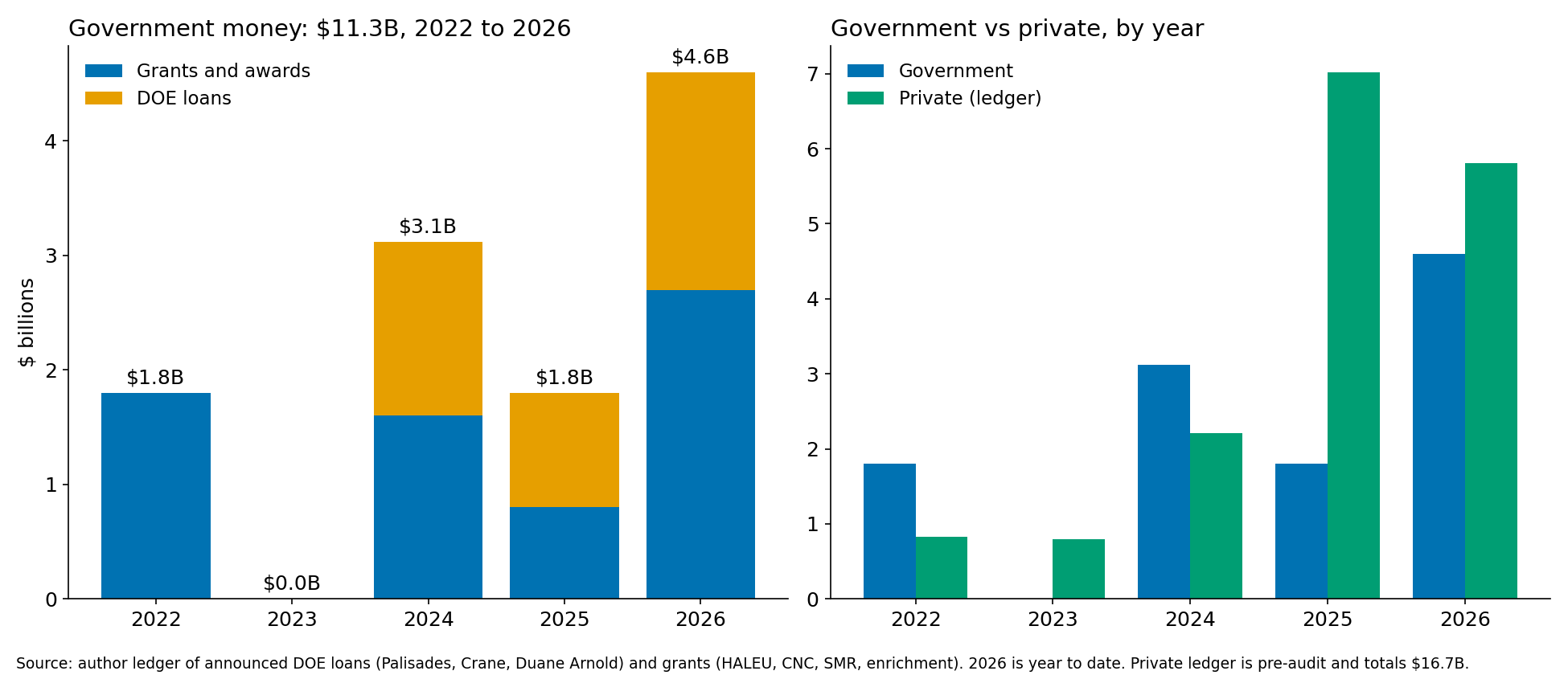
First, we follow the money, as America tends to pursue progress through capitalism. Since 2022, US private capital markets have invested ~$22B in the Nuclear Industry. Venture capital and private growth equity contributed half, suggesting the industry is still in its early stages. Companies innovating in the Fission space have raised billions from prolific investors, including Jane Street, Nvidia’s NVentures, and the almighty Sequoia. Fusion startups aren't left behind, with investments from General Catalyst, Bessemer Ventures, Bill Gates’ Breakthrough Energy Ventures, and more. The equity public market is estimated to have poured $7B into the nuclear industry, with Oklo and X-energy going public in 2024 and 2026, respectively. Net inflows6 into NLR 0.00%↑ , an ETF that invests in a bucket of nuclear-related stocks were about $3.9B over three years, against about $0.05B over the seven years before that. Private-sector risk capital is clearly not in short supply to propel nuclear forward.
Americans are innovating rapidly to address Nuclear’s numerous challenges, ranging from the fuel supply chain to reactor design. The industry is also attracting talent compared to before; IPEDS7 showed that the total Nuclear-related degrees (Bachelor’s, Master’s and PhD) fell about 26% from 2013 to 2021. Today, that number is up by 12%. It hasn’t been all schoolwork; applications to the Nuclear Regulatory Commission (NRC) for new kinds of modular reactors are on the rise. In 2010-2019, no formal applications for advanced reactors were filed; since 2020, at least one has been filed each year. Oklo, Kairos and TerraPower are a few of the companies that have applied. Several of these advanced reactor designs have reached criticality, meaning they work physically and could potentially generate electricity soon. An interesting example is Valar’s Ward 250, which was reported to have powered an Nvidia chip.
No major innovation can be sustainable without government support, and in a politically divided country like the USA, Nuclear is one topic with bipartisan continuity. In 2022, the IRA8 passed tax credits that keep existing reactors open and cut the cost of building new ones. Two years later, the ADVANCE Act transformed the NRC’s mission statement from focusing solely on safety to enabling nuclear technology while also creating a licensing path for fusion. Then, in 2025, under a new administration, four executive orders sped up NRC reviews and directed the Department of Energy (DOE) to test reactors faster. Even the widely debated OBBA9, which cut tax credits for wind and solar, left nuclear alone. Executive agencies, especially the DOE, have been front and center in this renaissance; they created a reactor pilot program that has produced five criticalities. Aside from regulation and programs, public capital is also funding Nuclear’s growth; about $30B has been announced and committed through various means, including loans and tax credits.
Your assumption after reading should be that in the near future, we will have a world where most (if not all) of the energy generated will be abundant, clean and sustainable. However, that is not the case; we are still very far from that world. Investor sentiment, especially with pre-revenue developers, is souring. Oklo, OKLO 0.00%↑ , led by Sam Altman is down about 81% from its 52-week high. The supply chain for nuclear fuel remains a bottleneck; Centrus Energy LEU 0.00%↑ , the main US company selling enriched uranium fuel, has produced about 1,900 kg of HALEU in total, versus more than 40,000 kg a year needed by 2030. Even 12 years after Sr. Jancita made that remark, we still haven't been able to harness Nuclear Fusion despite throwing circa $14.24B at it.
All hope is not lost, though, and these experiments will still yield plenty of positive results. My ambition is back, I’m optimistic, and you should be too.
Fusion is two small atomic nuclei joining into one bigger nucleus. The energy comes from the tiny loss of mass. It is the process stars use to make energy.
Fission is one large atomic nucleus splitting into two smaller ones. The energy comes from the tiny loss of mass. It is the process used in nuclear power plants today
A terawatt-hour (TWh) is a unit of energy equal to one trillion watt-hours. It measures how much electricity is produced or used over time. One TWh is roughly what 100,000 average US homes use in a year.
Capacity is how much electricity a power plant actually produced compared with the most it could have produced if it ran at full power the entire time. A plant with a 66% capacity factor produced two-thirds of its maximum possible output over that period.
A data center is a building full of servers, storage, and network gear that runs around the clock, and it draws electricity like any large industrial customer
Net inflows are the money put into an ETF minus the money taken out over a period. It is a measure of investor demand
IPEDS, the Integrated Postsecondary Education Data System, is the US Department of Education’s annual survey of colleges, which reports how many degrees schools award in each field.
The Inflation Reduction Act of 2022 is a law signed in August 2022 that created tax credits for clean energy, including nuclear, wind and solar.
The One Big Beautiful Bill Act is a law signed on July 4, 2025 that covers taxes and spending.